

Isabel Ferreiro
“Don’t be the judge of things; be their lover” sounds like one of those timeless maxim known to every human heart, and yet we live as if we had forgotten it, devoting ourselves more to judging than to loving.
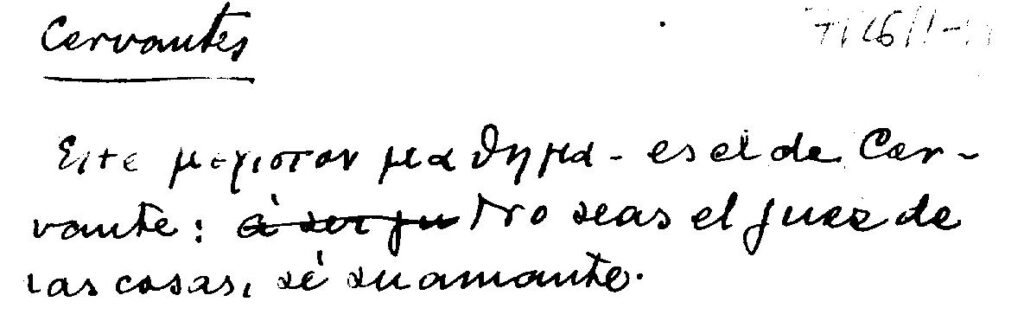
Ortega writes this phrase in a working note on “Cervantes and Don Quixote”, while preparing his first book, Meditations on Quixote. And there he expands on it a bit: “Every day I am less interested in passing judgment: rather than being a judge of things, I prefer to be their lover,” just two pages after his most famous statement: “I am myself and my circumstance, and if I do not save it, I do not save myself”. This statement already dismantles, at its root, every judgement directed outward; for if my circumstance is myself, whatever I project onto them inevitably falls back upon me.
Being a lover rather than a judge shows us how to save oneself within our circumstance: among others, in situations, in the world. Everything is inseparable from me; hence the invitation to remain with it without judgment, and to remain with oneself without condemnation. And without exception, for salvation renounces nothing—as A Course in Miracles says.
This oneness of the self with its circumstance predates by more than a century what is today called «unity consciousness». Ortega shares this view with Renan and with ancient philosophical traditions he has known and appreciated since his youth. I am one with my world, and therefore I cannot save myself without including it.
We all like the idea of saving the world. But a little realism reminds us who is actually holding whom. And it’s not about fixing it through conversation by dictating how things should be; nor is it about devoting ourselves to utopias while neglecting our own lives, for this entertaining path—even for the noblest cause—carries with it the flip side of condemnation. Thus, it’s unclear which we do more: saving the planet or condemning polluters, for example. And this—judgment—is what we should avoid.
“Desire what you can”, Ortega quotes Leonardo. And certainly, not judging is something within everyone’s reach; moreover, it is what saves us. Judging, on the other hand, condemns me to keep that judgment alive so that I can continue to be right.
Furthermore, the judgments I harbor in my mind operate within me—and in my world—without my knowing it, because, as science confirms, most of our inner life is unconscious. And this innocent yet coherent unconscious makes no distinction between “I” and the world, nor between one or the other; for it, everything is one, and everything is me. Therefore, what I believe I am dictating for another, I am in truth establishing for myself.
Kant expressed a related idea in his categorical imperative: “Act in such a way that you would will your behavior to become a universal law”. But the point is that we do not even need to will it. When I throw the stone —whether I hide my hand or not— it becomes part of my world. Indeed, by acting —and judging is an act— I legislate for myself and for the world. What I judge in another becomes a law for myself and for my world. I am, therefore, the sole authority in my life. I condemn myself, and I save myself.
So, if we want to save ourselves, what should we do with the accumulated judgments? Well, we must call them into question one by one, to open a space through which a higher knowledge can seep in.
The choice seems simple: to be a judge or a lover; to insist on being right or to accompany our circumstance; to condemn ourselves or to save ourselves. But is it really such a difficult choice?
Texts cited: [“Marburg Diary”], January 1907, Sunday, the 27th; “Working Notes on Cervantes and Don Quixote,” Ferreiro Lavedán, M.I. and Carriazo Ruiz, J.R., eds., Revista de Estudios Orteguianos, no. 10–11, 2005; Meditations on Quixote (1914); “Letter to a Young Argentine Studying Philosophy” (1924), in El Espectador III
Deja una respuesta