
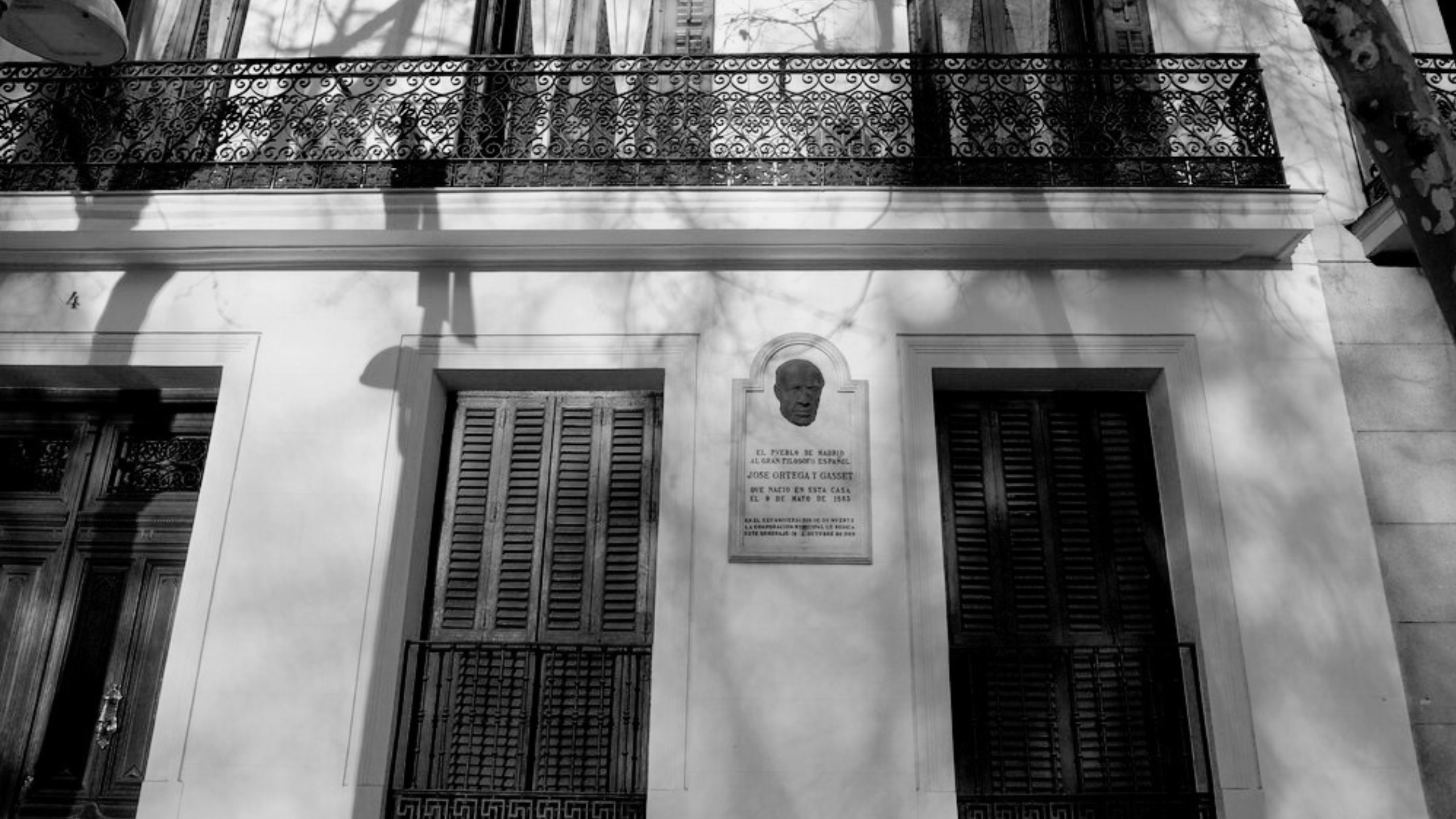
| 1883 | May 9th, born in Madrid. |
| 1891 | He enters the Jesuits school “San Estanislao” in Miraflores del Palo (Málaga). |
| 1897 | He obtains his bachelor degree. He studies at the University of Deusto: Law and Philosophy. |
| 1899 | He continues both degrees at the University of Madrid (Universidad Central). |
| 1901 | He gives up studying Law. |
| 1902 | He obtains his universitary degree in Philosophy (Filosofía y Letras) at the University of Madrid (Universidad Central). He publishes his first article, titled «Glosa. A Ramón del Valle Inclán», in the newspaper Faro de Vigo. |
| 1905 | He travels to Germany for the first time, and studies at the University of Leipzing. |
| 1907 | He goes back to Germany. There, he studies in Berlin and Marburg. Once back in Madrid, he contributes to the foundation of the magazine Faro. |
| 1908 | He becames Professor of Psichology, Logic and Ethics at the Escuela Superior de Magisterio (Teachers Universitary College). |
| 1910 | He marries Rosa Spottorno. He becames Professor of Metaphysics at the Universidad Central, succeeding Nicolás Salmerón. Lecture at El Sitio society (Bilbao) about: «Pedagogía social como programa político» (Social pedagogy as a political programme). |
| 1911 | He travels again to Germany. His first son, Miguel Germán, is born in Marburg. |
| 1913 | He founds the Liga de Educación Política Española (Spanish Politics Education League). |
| 1914 | His first daugther is born, her name: Soledad. Lecture at the Teatro de la Comedia, in Madrid: «Vieja y nueva política» (Old and New Politics). He lives at the Casa de Oficios, in El Escorial, a small historical village northern Madrid. He publishes his first book: Meditaciones del Quijote (Meditations on Quixote). |
| 1915 | Foundation of the magazine España. |
| 1916 | He starts the periodical publication El Espectador (The Spectator). First transatlantic travel to Argentina, accompanying his father (July-January 1917). His son José is born in Madrid. |
| 1917 | El Espectador II appears. He publishes the polemic article «Bajo el arco en ruina» (Under the ruinous arch), which provoques the end of his colaboration in El Imparcial, the family newspaper. In december he founds El Sol with Nicolás Urgoiti. |
| 1918 | Foundation by Urgoiti of the Calpe publishing company. Ortega becames director of the books collection «Biblioteca de las Ideas del siglo XX» (Library of the XXth century Ideas). |
| 1921 | He publishes España invertebrada (Invertebrate Spain) and El Espectador III. |
| 1922 | José Ortega Munilla, his father, is dead. |
| 1923 | He founds the Revista de Occidente (Western Review). He publishes El tema de nuestro tiempo (Ortega’s first translated book into English: The Modern Theme). |
| 1925 | El Espectador IV. |
| 1926 | El Espectador V. |
| 1927 | El Espectador VI. |
| 1928 | Second transatlantic travel to Argentina. Lectures about «Introducción al presente» (Introduction to the present) and «Hegel y la historiografía» (Hegel and historiography). |
| 1929 | January: return from Buenos Aires. February: Opening lesson at the Universidad Central of the course ¿Qué es filosofía? (What is Philosophy?). March: The University on strike against dictatorship, leading the Federación Universitaria Española (FUE: Spanish University Federation). The Universities are closed and several Professors renounce their chairmanships, Ortega y Gasset among them. October 24th: The first article of the journal series La rebelión de las masas (The Revolt of the Masses) appears in El Sol (Madrid) and in La Nación (Buenos Aires). El Espectador VII. |
| 1930 | January: End of the dictatorship of Primo de Rivera. Lecture: «Misión de la Universidad» (Mission of the University). November: El Sol publishes «El error Berenguer» (Berenguer mistake) La rebelión de las masas is published as a book, achieving an immediate success. |
| 1931 | February: The Agrupación al Servicio de la República (Group for the Service of the Republic) publishes a manifest, signed by Ortega, Pérez de Ayala and Marañón, among others. April 14th: Fall of Monarchy and proclamation of the II Spanish Republic. June: First republican elections. Ortega became member of Parliament as a representative of the electoral district of León. December 6th: Lecture in the Ópera cinema: Rectificación de la República (Rectification of the Republic). La redención de las provincias (Provinces redemption). He writes articles for both newspapers Crisol and Luz. |
| 1932 | July: Participation in the debate discussing the Catalonia self-government right (autonomía). October 29th: The «Asociación al servicio de la República» publishes a dissolution manifest in Luz. |
| 1933 | At the Universidad de Verano (Summer University, Santander) is hold the course Meditación de la técnica (Meditation on Technics). He publishes his last political article in El Sol: «En nombre de la nación, claridad» (In the name of the Nation, clearness). |
| 1934 | He travels to Germany for familiar purposes. He visits Edmond Husserl. El Espectador VIII appears. |
| 1935 | He publishes Historia como sistema (History as a system) in its English version: Philosophy and History, in a volume dedicated to Ernst Cassirer. |
| 1936 | War breaks out on july 18 th. Ortega has to move to the Residencia de Estudiantes. August 30th he leaves Madrid, and the day after he embarks in Alicante towards Marselle. He settles in Paris. |
| 1938 | Lectures at several Dutch Universities, invited by Professor Huizinga. Very severe illness. |
| 1939 | His third travel to Germany with scholar purposes. He publishes Ensimismamiento y alteración. |
| 1940 | Lectures in Buenos Aires on «El hombre y la gente» y «La razón histórica» (Historical reason). |
| 1941 | He publishes Historia como sistema y Del imperio romano. |
| 1942 | Back to Europe, he settles in Lisboa (Portugal). |
| 1943 | Lectures Introducción a Velázquez. |
| 1944 | Lectures at the University of Lisboa on «La razón histórica». |
| 1945 | He visits Spain for the first time after Civil War. |
| 1946 | First and last public lecture at the Ateneo in Madrid after Civil War: «La idea del teatro». |
| 1948 | He found the Instituto de Humanidades. The series of lectures on Una interpretación de la historia universal is hold. |
| 1949 | He travels to the United States of America, participating in the centenary of Goethe celebrated in Aspen (Colorado). Lectures in Hamburg and Berlin (Germany). |
| 1950 | He teaches the course El hombre y la gente (Man and People) at the humanities institute he founded, in Madrid. |
| 1951 | He participates in the meetings of Darmstad (Germany). There he meets Heidegger. He settles in München (Germany). He obtains both Honoris Causa Doctorates from the Universities of Marburg (Germany), and Glasgow (Scotland). |
| 1953 | Lectures in Edimburg and London. He takes part again in the meetings of Darmstad. |
| 1954 | Lectures in Munich and other german cities. |
| 1955 | His last lecture in Venice. October 18th, he died at his home, on Montesquinza street in Madrid. |